My Perspective on Teaching
Students of ecology have it hard! They must learn to speak the languages of mathematics (e.g., functional responses), computers (vegan package, anyone?), and metaphors (e.g., Red Queen dynamics) all at once. Further, plenty of models and metaphors have come in and out of favor as our field has developed. I equip students to interpret theoretical models, work with data in R, and understand ecological concepts. In addition, my teaching also considers historical legacies. A historical approach to our discipline is useful because ecological knowledge has not developed linearly but in fits and starts out of raucous debate. For example, the SLOSS debate, about whether a Single Large or Several Small ecological reserves are better for preserving biodiversity, continues to receive some attention in the literature 50 years on!
Beyond Disciplinary Ecology

In addition to my strictly-ecology teaching (e.g., Biodiversity Science and Applications in Fall 2023), I’ve taught interdisciplinary courses (e.g., Race, Genomics, and Society) that get at the bidirectional relationships between nature, science, and people. In a rapidly changing world,
For those interested in inequities in the history of biology, check out this graduate syllabus about Inclusion, Diversity, Equity, and Anti-racism in Biology, which I co-wrote with Raymond Allen and Lauren Carley. link to syllabus. You can also check out Resources for Inclusive Evolution Education, for which I contributed to the module on Plasticity.
Teaching for the Public
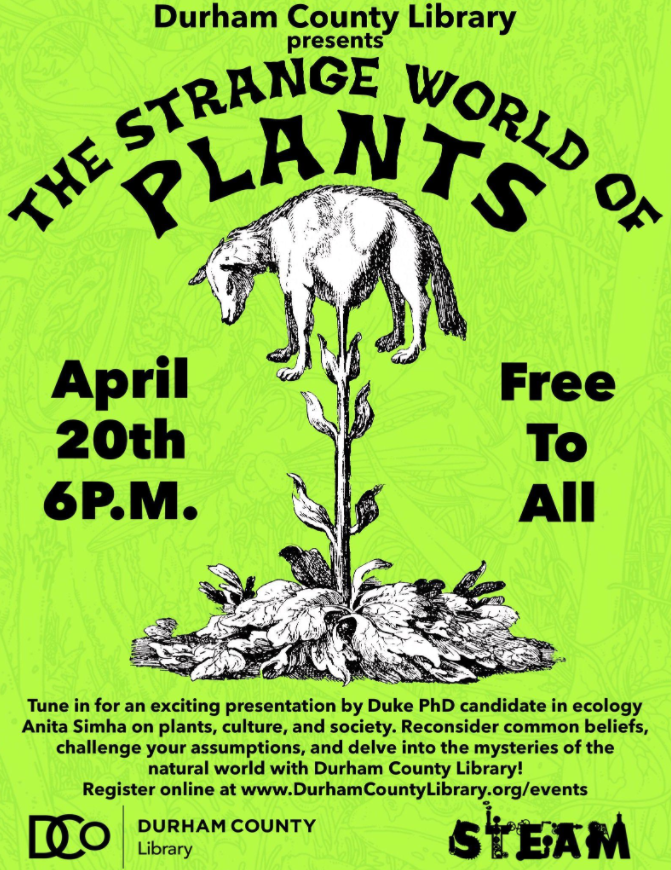
To drive public interest, I focus on the intersection of plant worlds and human worlds, with topics like “Species Interactions in Your Garden” and the “Strange World of Plants.” I’ve given multiple large public talks for Durham, Wake, and Vance County Libraries in NC, as well as for Duke Gardens. The Durham and Wake County Library systems raised me, so I have loved being able to share expertise on plant ecology with my community.
I am leading upcoming events at the LSU Museum of Natural Sciences and Louisiana Wild Society – more soon!